Skip to content
Casa Plac

Gatteo, the town
where «Romagna mia» was born.

It's not a figure of speech. Secondo Casadei was born in Gatteo, in the hamlet of Sant'Angelo, on 1st April 1906. He wrote «Romagna mia» in 1954, in Gatteo Mare, in the house where the lyrics are engraved on the facade.

1906 – 1971

Secondo Casadei,
who was born here

Born in Sant'Angelo di Gatteo into a family of tailors, at sixteen he was already playing in an orchestra. In 1928, at twenty-two, he put together a sextet with saxophone and drums — instruments that, at the time, no one used in a Romagna dance band.

He composed 1,078 pieces. One of them, written in 1954, became the song that in Italy everyone can sing by heart even without knowing they know it.

In Gatteo Mare, in Piazza Romagna Mia, there is a stone with the Maestro playing the violin and a line from the song, the work of artist Tito Neri. A little further on, an iron heart where everyone takes a photo.

The house where he lived and composed is on Via I Maggio, and the lyrics are engraved on the facade.

And that's not all: Raoul Casadei as well, the nephew who brought liscio to television, was born in Sant'Angelo di Gatteo — on 15 August 1937. Both fathers of Romagna liscio were born in this hamlet.

In Sant'Angelo, since 2009, there's a roundabout dedicated to Secondo Casadei that reproduces the silhouette of his orchestra. The Secondo Casadei Museum is instead in Savignano sul Rubicone, 7.3 km away: it contains the studio where he worked from 1957 to 1971, and his violin. He is buried there, under a statue by Tito Neri — the same sculptor of the stone in Piazza Romagna Mia.
In September

La Settimana del Liscio

Live orchestras and dancing in Piazza della Libertà, in Gatteo Mare. The municipality schedules it every year.

In early July · free admission

Il Festival di Sanliscio

The first festival entirely dedicated to liscio, conceived by Claudio Cecchetto and directed by Moreno «Il Biondo». It takes place at Arena Rubicone.

On 15 August

Balamondo

The festival where liscio meets the music of the world, directed by Mirko Casadei. The Gatteo Mare stop takes place in Piazza Romagna Mia, on Raoul Casadei's birthday.

Something that isn't true yet, so we'll put it in the future tense: since 2023 the process has been opened to nominate the liscio dance as UNESCO intangible heritage. It's a candidacy in preparation, not a recognition already obtained.

7 minutes · 4.3 km from the house

The castle that wasn't
supposed to be on the plain

The Emilia-Romagna Region calls it the only example of a lowland castle in the Rimini area. Malatesta castles stand on the hills: this one doesn't.

It rose in the 13th century, perhaps over a Roman encampment. Nearly square plan, one tower and five bastions, all around a water-filled moat and a wooden drawbridge.

From 1311 it belonged to the Malatesta of Verucchio, who strengthened it. In 1452 the pope granted it in fief to the Counts Guidi di Bagno, who remained until 1656.

In the eighteenth century the walls were lowered, the moat filled in with earth and the drawbridge replaced by a stone bridge: it's still the one you cross today to enter the courtyard. Above the entrance, the 17th-century civic tower.

Two corner towers are original; the front and the third tower were rebuilt after the war.

Admissionfree
When the inner courtalways open
Accessibility inner courtyes
From Casa Plac7′

The walkway on the walls opens only for cultural initiatives: it isn't open every day. The patronal feast of San Lorenzo, on the weekend of 10 August, is held right in the castle courtyard.

Nearby

The Oratory of San Rocco, dating to the 14th century with a documented intervention in 1484, preserves votive frescoes linked to plagues. However, it is normally closed: it opens only during exhibitions and events.

Not far away the bell tower of Sant'Antonio Abate stands alone: the church, from 1467, was destroyed by bombings in 1944.

The Rubicone, and the question
that's never been settled

The territory of Gatteo is bounded by the Rigossa stream and the Rubicone, and reaches the Adriatic. At the mouth, the river separates Gatteo Mare from San Mauro Mare.

On the river, in Gatteo Mare, there's a wooden footbridge with, at its center, a bronze bust of Julius Caesar and the inscription «Alea iacta est». Local tradition says that touching his nose brings good luck.

As to whether this is the river Caesar crossed in 49 BC, however, scholars have argued for centuries: there are three candidates. In 1933 a government decree closed the matter by law, and Savignano di Romagna became Savignano sul Rubicone. Historians remain unconvinced: the controversy is still open today.

At the mouth there's also a trail of about 700 meters from which you can watch waterbirds, in a protected area.

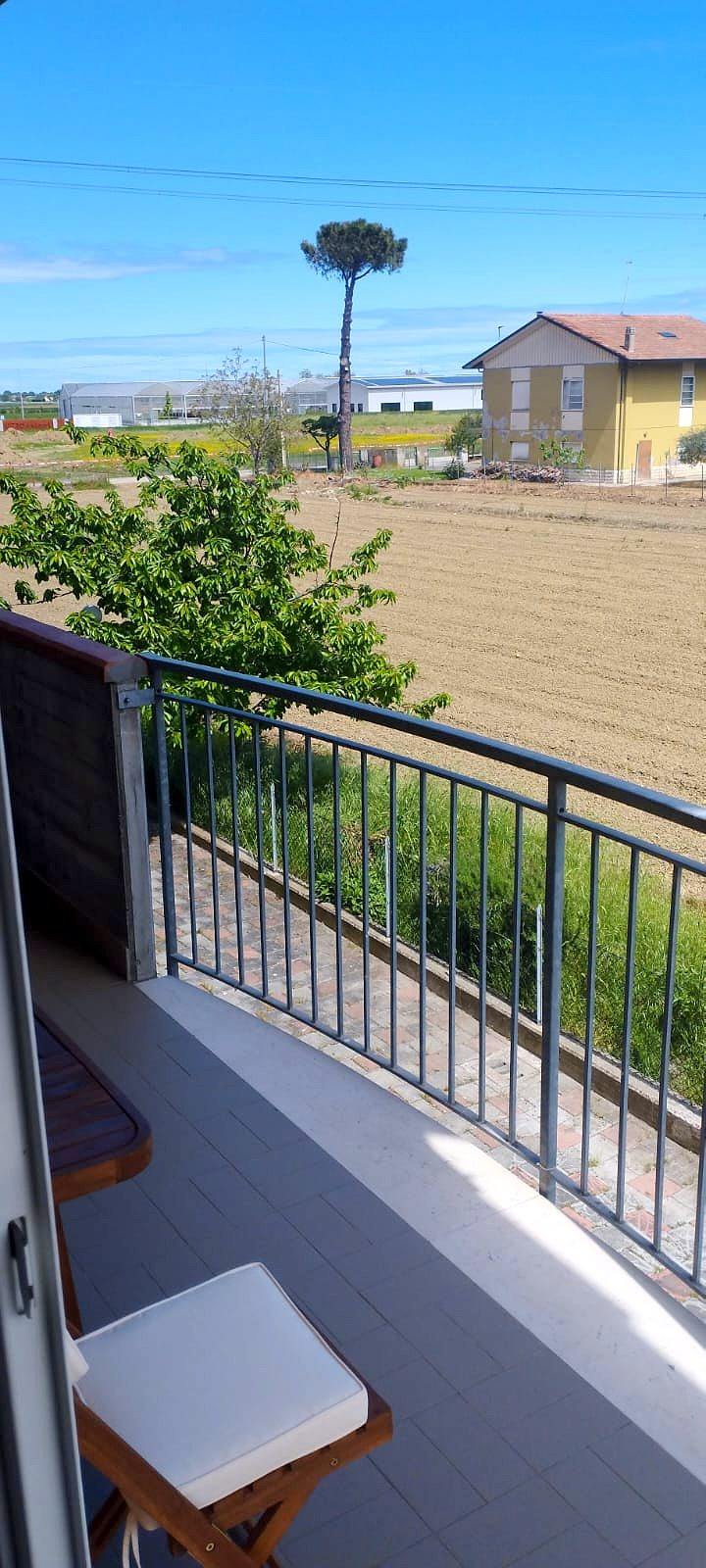
The cultivated fields of the Gatteo plain seen from the balcony of Casa Plac

The Gatteo plain, from the balcony at home.

9 minutes · 7.3 km from the house

Gatteo a Mare

The hamlet on the sea. Just under one square kilometer, and in summer it becomes another town.

Blue Flag 2026

The beach

About 700 meters of equipped shoreline and thirty establishments. The sand slopes gently and the sea stays calm thanks to the rock breakwaters: the municipality describes it as an open-air pool.

For this reason it's recommended for families with small children, and the municipality also claims the Bandiera Verde dei pediatri, the award for child-friendly beaches.

In the evening

The pedestrian center

Piazza della Libertà and Piazza Romagna Mia are pedestrian-only all year. In summer evenings, much of Viale delle Nazioni and Viale Giulio Cesare also becomes a limited traffic zone.

Verses from Romagna songs are written on the avenues' light installations.

From May to September

For kids

A Ferris wheel twenty-five meters high with eighteen cabins, at the Don Guanella Gardens, operating in the evening. And Topolino Park, on Viale delle Nazioni: kids' car track, go-karts, mini golf, trampolines.

The market, and when it changes streets

In Gatteo a Mare it's on Monday morning, from 7 to 13. From October to April it's held in Piazza della Libertà; from 1st May to the end of September it moves to Via Trieste, Viale Giulio Cesare and the surrounding streets. In summer there's also an evening market on Tuesdays and «Il Sabato di Gatteo Mare».

Sant'Angelo

The most populated hamlet of the municipality, and the least touristy. Casa Plac is on this side of Gatteo, towards the countryside.

The full name is Sant'Angelo in Salute, and it appears for the first time in a document from 1070, when the bishop of Rimini assigns the parish church to his canons.

Today it's the most populated and most industrious hamlet of Gatteo: it isn't a tourist resort, and that's exactly why at night you don't hear anything.

The market square is named after Arturo Fracassi, born here in 1899: luthier and bow maker, recognized among the best makers and repairers of bows. The Museo degli Strumenti Musicali in Cesena preserves his first violin, from 1924, and his tools of the trade.

And here, seven years after Fracassi, were born Secondo Casadei and, thirty years later, his nephew Raoul.

Distances from the house

Supermarket 2.5 km4′
Pharmacy Via Salvador Allende · 3.1 km5′
A14 exit is within the municipality6′
Gatteo and the castle 4.3 km7′
The beach Gatteo a Mare · 7.3 km9′

In Sant'Angelo there's also a tennis club with indoor courts, open all year, and a sports center with a gym and a football field. All distances

Three things no one
expects from Gatteo

An engineer from here built the Caribbean fortresses

The Antonelli were a family of architects and military engineers in the service of the kings of Spain. Battista Antonelli, born in Gatteo in 1547, designed the Castillo San Felipe de Barajas in Cartagena, the Castillo San Felipe del Morro in San Juan, Puerto Rico, the Castillo del Morro in Havana, the Fort San Lorenzo in Panama, and the expansion of San Juan de Ulúa in Veracruz.

These are fortresses that today appear on the World Heritage lists. They were designed by someone born in this lowland town.

Garibaldi passed through here

On 1st August 1849, heading to support the resistance in Venice, Giuseppe Garibaldi crossed the territory of Gatteo with over two hundred Garibaldini. He would board shortly after in Cesenatico.

A voice from La Scala is buried in Gatteo

Lina Pagliughi, a soprano born in New York in 1907, sang at La Scala, at the Metropolitan and at Covent Garden. In 1929 she married the tenor Primo Montanari, a native of Gatteo; in 1940 the two bought «Villa Lina» in Gatteo Mare, where they settled. She is buried in the cemetery of Gatteo, and in Gatteo Mare there's a square named after her.

Gatteo's year

The events that the municipality schedules every year. Exact dates change: here you'll find the timeframes.

Buon Anno Gatteo Piazza Vesi, Gatteo1st January
Cantarelle the sweet Romagna fritter, in Gatteo MareMay
Festa Romana costumed reenactments, Viale Giulio CesareJune
La Notte Rosa the New Year's Eve of summer · from 2025 moved forward to the solsticelate June
Carnevale dell'Adriatico floats, Gatteo MareJuly
Festa di San Lorenzo in the castle courtyard10 August
Ferragosto Live Gatteo Mare14 August
Settimana del Liscio Piazza della LibertàSeptember
Natale a Gatteo in the three localitiesDecember
Mercato di Sant'Angelo Piazza Arturo Fracassievery Wednesday

Event calendar of the Municipality of Gatteo and the municipality's official tourist website, checked in August 2026. For the exact dates of the current year it's always best to contact the tourist office in Gatteo a Mare.

Sleep in the town
of «Romagna mia»

Casa Plac is in Sant'Angelo, the same hamlet where Secondo Casadei was born. Casa Plac is in the same hamlet where Casadei was born. It's not a figure of speech: it's the address.